Is your cake/bakery pricing
actually making you money?
Pick one product. Run your real numbers.
Find your profit gap.
Ingredients + Labour + Overheads + Profit.
Cakes, cupcakes, cookies, slices, desserts, catering and more.
Home kitchen to a 500sqm commercial bakery, a team, a drive-thru and a wholesale division.
A booked-out bakery
can still have a
pricing problem.
Orders coming in tell you people want what you make. They do not tell you whether those orders are priced properly, or whether the price is covering the ingredients, the hours you work, the cost of running the business, and profit.
You can be baking and decorating all week, answering messages at night, handing over orders all weekend, and still wonder why the money left at the end doesn't match the amount of work going in. Because revenue isn't the same as profit.
And if your prices started with "what did I charge last time?", "what are other bakers charging?" or "that sounds about right", there's a good chance the number underneath them has never actually been calculated.
Ingredients get counted. Labour usually doesn't. Overheads almost never do. Profit, the part that pays the business for existing rather than paying you for the work, gets left out completely.
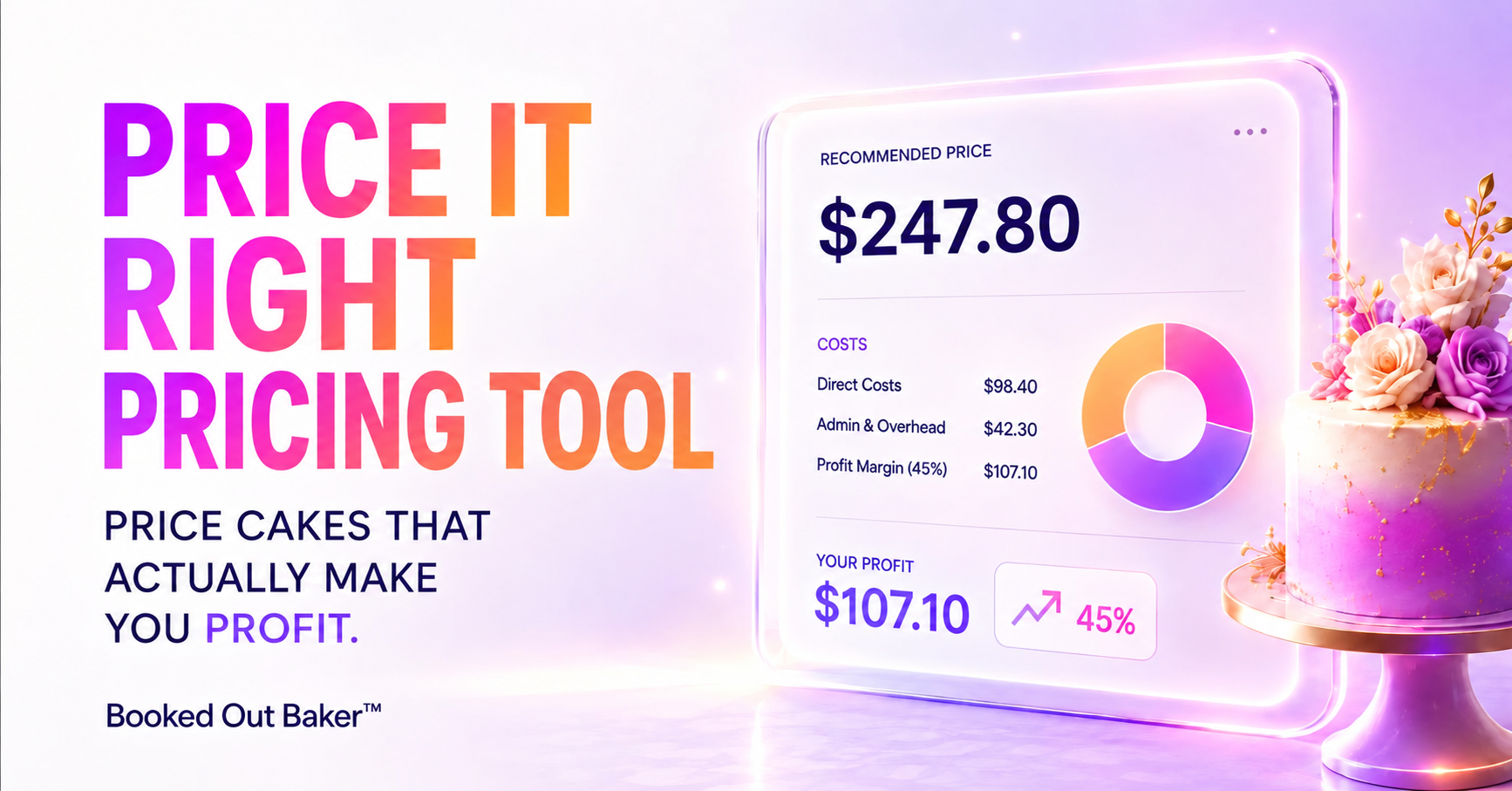
That's what Price It Right is built to do. Pick one real product you sell regularly. Put your actual numbers through the tool. See what it needs to sell for, then compare that with what you're charging now.
Maybe you're closer than you thought. Maybe there's a gap. Either way, you'll know exactly what each order is leaving you once everything is paid for.
Sometimes the answer isn't more orders. It's making more profit on the orders you've already got.
This is for you if you run a cake/bakery business and…
You're already selling products to paying customers.
You're busy, but aren't sure whether your pricing properly reflects your costs.
You still price some products from memory or from what you charged before.
You check what other bakers charge before deciding your own prices.
You know your ingredient costs better than you know your labour and overheads.
You want to understand your numbers without becoming an accountant.
Home baker or commercial bakery. Cakes or cookies. Cupcakes, slices, desserts or catering. If you make it and sell it, you need to know what it's actually earning you.
Cost everything that goes into the product
Every physical thing that leaves your kitchen with that order, including the small items that quietly add up and rarely make it into the price.
- →Ingredients and fillings, costed properly per product
- →Boards, boxes, dowels, colours and packaging
- →The little things you currently absorb without noticing
- →One clean materials figure for the product you chose
Count the whole order. Not just the making.
Decorating for three hours doesn't mean the order took three hours. This counts every hour the order actually takes, from the first message to the moment it leaves your hands.
- →Messages, quoting and back-and-forth
- →Shopping, prep, baking and decorating
- →Cleaning, packaging and handover
- →An hourly rate you can defend, applied to real hours
Every order needs to carry part of the business
Power. Gas. Water. Insurance. Software. Equipment. Repairs. Rent or kitchen costs. They're not attached neatly to one cookie box or cake, but your bakery still has to pay them.
- →Power, gas, water and rent or kitchen space
- →Software, insurance and accounting
- →Equipment, repairs and replacement
- →How to account for them without turning you into an accountant
Paying yourself isn't the same as making a profit
Labour pays you for doing the work. Profit pays the business for existing, growing and taking the risk. They're not the same thing, and most bakery pricing includes neither.
- →The difference between wages and profit
- →Where the margin goes in the calculation
- →Why "I paid myself something" isn't profit
- →A margin that lets the business fund itself
Now put the two numbers side by side
What you're currently charging, next to what your numbers calculate. That difference is your price gap. Maybe it's tiny. Maybe it's not. Either way you'll know exactly how much profit each order has been leaving on the table.
- →Your calculated selling price for one real product
- →The gap between that number and your current price
- →What that gap becomes across a month of orders
- →A method you can repeat across the rest of your range
This is where a small pricing gap gets expensive.
This is the illustrative example used inside the tool.
The number she'd always used, based on what felt reasonable.
Ingredients, labour, overheads and profit, all included.
That's one example on one product. The point isn't that your gap will be $72.50. It's that until you calculate it, you don't know whether there's a gap at all, or what repeating that gap across your orders could mean.
Example only. Your numbers will depend on your own costs, labour, overheads and current pricing.
Everything you need to find more profit in your bakery business
"Being good at baking and being good at pricing are two completely different skills."
Clare McRae · Founder, Booked Out Baker™

I spent 17 years running a real bakery business.
I built Miss Naked Cakes from my home kitchen into a commercial cake business in a 500sqm warehouse with an amazing team, a drive-thru, a wholesale division, you name it. I ran it for 17 years before selling it to my manager in November 2025.
You can be talented. You can be booked out. You can have customers coming back again and again. And the numbers underneath what you're selling can still be wrong.
That's why I built Price It Right. Not to tell you to "charge your worth", but to show you what your work is really worth and what you need to charge to be paid properly for it.
Pick one product. Find out what it's really earning you. Everything else gets easier from there.
Everything you want to know.
Tap any question to open it.
Is this only for cakes? +
No. The same method works for anything you sell: cupcakes, cookies, slices, desserts, catering items. You're working out the true cost of making the product, including ingredients, labour and overheads, then pricing from the numbers instead of guessing. Once you've done it once, you've got a method you can use across the other things you sell too.
Is it just a spreadsheet? +
There is a customised detailed spreadsheet included, but there is also an online tool, and the important bit is that you're not left staring at a bunch of boxes wondering what to put where. The five sections walk you through one of your real products piece by piece, so you can see what it's actually costing you, then work out what you need to charge for it to be profitable. You can choose if you want to use the spreadsheet or the online interactive worksheet.
How long will this take? +
The tool is built in five short sections, each around ten minutes, plus the time it takes to enter your own numbers. Work through it in one sitting or come back to it whenever suits. It's yours to use whenever you need it.
Which product should I use? +
Choose something you sell regularly. Not your smallest cupcake order and not the seven-tier wedding cake that nearly ended your will to live. A normal middle-of-the-road product is ideal.
Do I need perfect records before I start? +
No. Use the best numbers you have now and tighten them later.
Is this a subscription? +
No. Price It Right is a single one-time payment, not a subscription.
What happens after I purchase? +
Your payment is processed securely and your access is created automatically. Check the email address used at checkout.
Do you guarantee I'll make more profit? +
No. Price It Right gives you a clear pricing calculation. Your actual business results depend on your costs, market, pricing decisions, customers and implementation.
What is the refund policy? +
Because this is a digital product and access is provided after purchase, change-of-mind refunds are not ordinarily offered. This does not affect rights available under applicable consumer law.
You don't need to reprice your whole bakery tonight.
Pick one product you sell regularly. Put the real numbers underneath it. See what it's actually costing you, what it needs to sell for, and whether there's a gap. Then take the method and use it on the next one.